
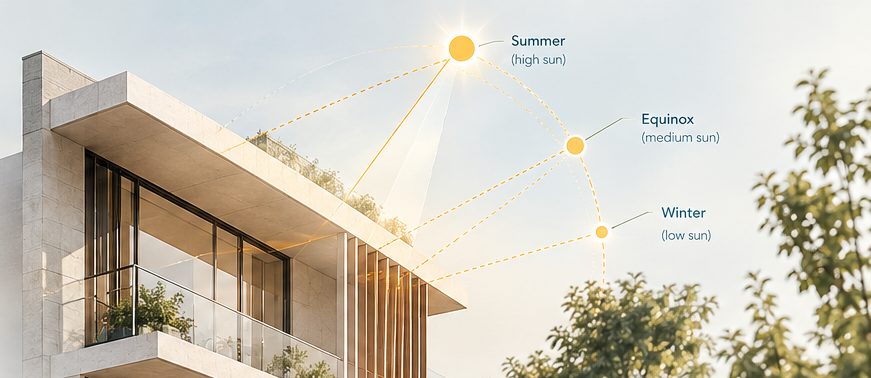
Shading is often approached through familiar rules: an overhang on the south façade, vertical fins on the east and west, or a shading depth based on a standard proportion.
These rules can be useful starting points. But they do not tell us when the building actually needs solar protection.
Solar exposure changes throughout the day and across the year. The period when solar gains become undesirable is not necessarily the same as a conventional calendar season. A more useful question is:
When does the building actually need protection from the sun, and when should useful solar gains be allowed?
That shift turns shading from a fixed architectural detail into a climate-responsive design decision.
Shading Is a Climate Problem Before It Is a Geometry Problem
A shading device is ultimately a geometric object, but its effectiveness depends on the climate conditions in which it operates.
A fixed shading strategy does not respond to changing outdoor conditions. The sun moves, thermal conditions change, and the building’s need for solar protection changes with them.
Instead of beginning with “What type of shading device should I use?”, the analysis can start with: during which periods is the building actually overheated? That provides the climatic context in which any shading strategy needs to be evaluated.
Defining the Overheated Period
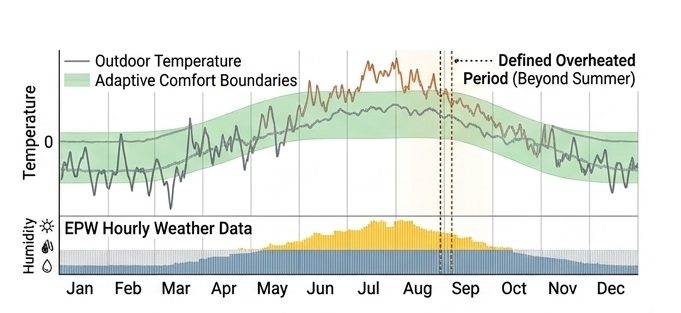
An EPW weather file provides the hourly climate data needed to investigate outdoor conditions. Tools such as Climate Consultant can help visualise temperature distributions and comfort boundaries.
An overheated period does not have to be defined simply as “summer.” Using frameworks such as the ASHRAE 55 Adaptive Comfort model, overheated hours can be identified from hourly thermal comfort boundaries. The result varies significantly by climate. In extremely hot climates, the overheated period may extend far beyond a conventional definition of summer.
Climate determines when shading needs to work.
Then Ask: Where Is the Sun?
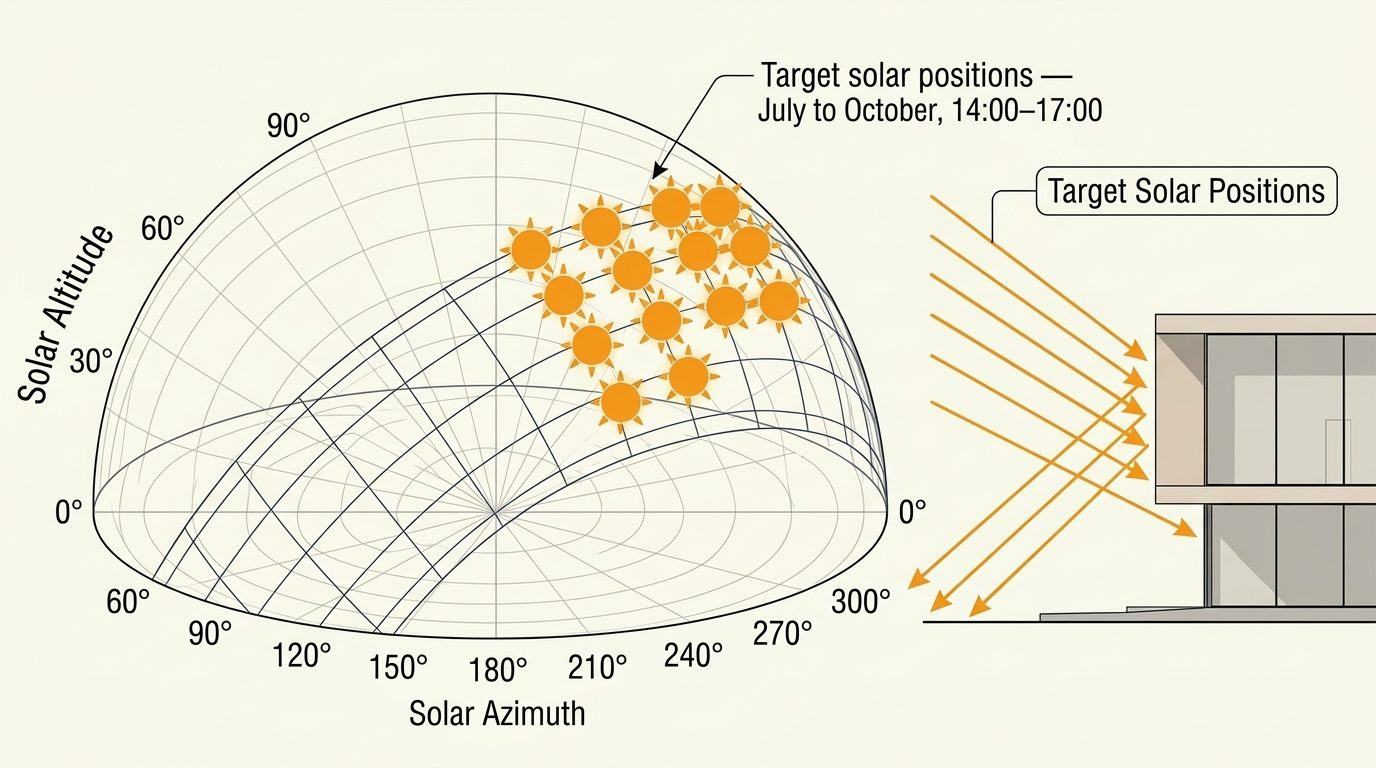
Once the relevant period has been identified, the next question is geometric: where is the sun during those hours?
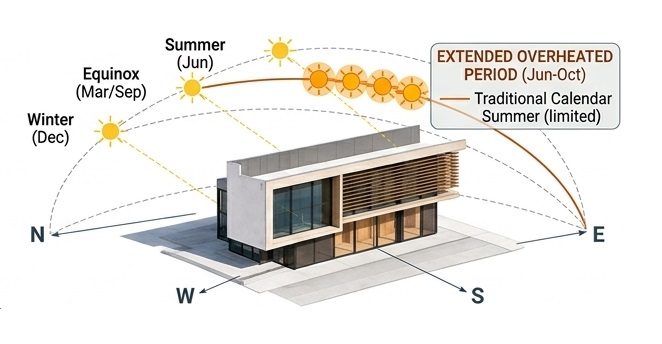
Solar position changes continuously with location, time of day and time of year. Understanding solar position, including solar altitude and azimuth, during the relevant hours allows a shading strategy to be evaluated against actual conditions rather than a single assumed sun position.
This creates a clear connection:
- Climate tells us when protection matters.
- Solar geometry tells us where the sun is.
- Geometry translates that information into a shading strategy.
The objective is not to block as much sunlight as possible. It is to control unwanted solar exposure during overheated periods without unnecessarily compromising useful solar gains at other times.
From Rules of Thumb to a Testable Workflow
Conventional shading rules still provide useful design intuition. The problem is treating them as the final answer without testing them against the climate and solar conditions of the project.
A more robust workflow is:
Climate dataOverheated periodSolar positionShading geometryPerformance evaluation
- Climate data: what are the environmental conditions?
- Overheated period: when are thermal conditions outside the relevant comfort boundaries?
- Solar position: where is the sun during those hours?
- Shading geometry: how should the building respond?
- Performance evaluation: does the proposed strategy achieve the intended response?
This approach turns shading from a prescriptive detail into a design variable that can be tested and compared.
What This Changes for the Design Team
For architects, shading should not be treated only as a façade detail. Its geometry is connected to climate, orientation and solar position.
For energy modellers, solar exposure needs to be interpreted using the conventions and assumptions of the simulation environment, including the differences between ASHRAE and DOE azimuth conventions.
For the wider project team, the conversation becomes clearer. Instead of “this is the standard shading depth for this orientation,” the question becomes:
Which solar conditions are we trying to control, during which hours, and why?
That question connects the architectural decision to measurable environmental conditions.
The Real Value of Solar Geometry
Solar geometry can easily become a collection of equations. Its practical value in building design is simpler: it helps explain when and where the sun reaches the building.
Combined with climate data, that information provides a basis for developing shading strategies that respond to the actual conditions of a project. The goal is not necessarily to block solar exposure throughout the year.
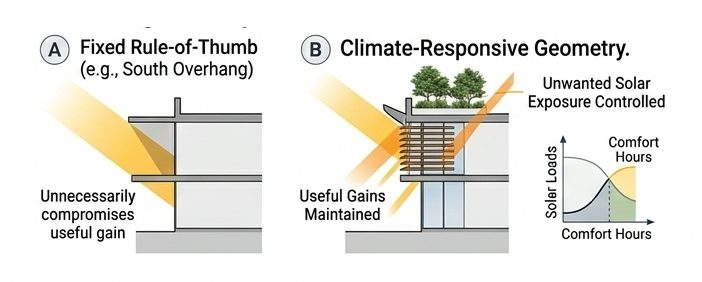
The goal is to understand when solar protection is needed and how the building envelope can respond. That is where passive shading becomes more than a façade detail.
Source
This article is based on Session 01 of the MAEDX Academy workflow guide, which covers the solar position equations, azimuth conventions and the full climate-data workflow in detail.
OpenStudio / EnergyPlus Workflow GuideMaedeh Mohit, MAEDX Academy · PDF, 44 pages, 1.5 MB